In automated assembly processes, tightening screws from bottom to top is a highly challenging operation. Since the direction of gravity is opposite to the tightening direction, screws are prone to retreating, tilting, or even falling before entering the threaded hole. This not only affects assembly efficiency but can also lead to equipment failure or product damage. So, how can this problem be effectively solved?
1. Why is it easy to fail when tightening screws from bottom to top?
In traditional automatic screw feeding systems, screws are usually delivered to the screwdriver bit by gravity or airflow. When the tightening direction changes to upward, the screw’s own gravity becomes an instability factor, often leading to the following problems:
Screw retreat: Before the bit is fully pressed against the screw, the screw may slip downward due to gravity.
Screw fall: Unstable clamping or inadequate screw feeding can cause the screw to fall directly before tightening starts.
Oblique entry: Misalignment or insufficient perpendicularity between the screw and the threaded hole can cause jamming, thread stripping, or tightening failure.
These issues are particularly prominent in confined spaces and multi-angle assembly scenarios, requiring a structurally stable feeding and clamping mechanism for assurance. Especially in automotive body-in-white assembly, the positions of bolts and threaded holes are often strictly constrained by the body structure, forcing tightening operations to be performed in very limited spaces. The difficulty increases significantly when tightening bolts from bottom to top. Furthermore, under the influence of gravity, screws can easily deviate from their path, making it hard to enter the threaded hole accurately and vertically, which further complicates the tightening operation.
2. Danikor’s Solution
2.1 Blow-Feeding Module with Screw Retention Mechanism
The blow-feeding module is a common screw feeding method in automatic bolting. Its principle uses compressed air to blow the screw from the feeding system to the front end of the tightening tool. However, when tightening screws from bottom to top, the screw is prone to retreating due to gravity after reaching the tightening position. To address this, a blow-feeding module with a screw retention mechanism can be used.
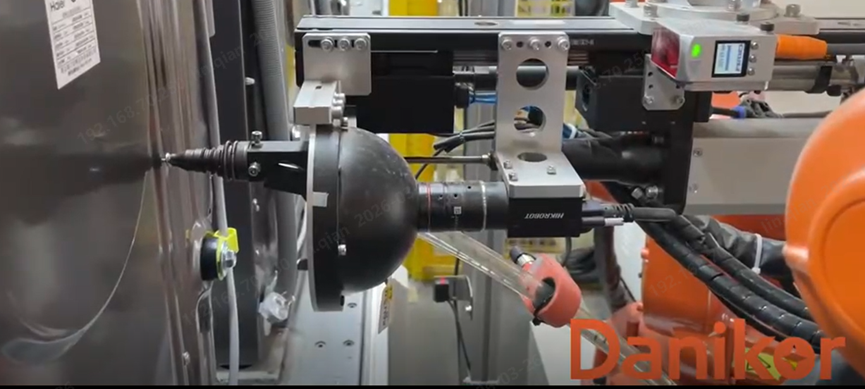
The core of the screw retention mechanism lies in the design of its clamping block, ensuring the screw remains vertical and stable. Additionally, the distance the screw protrudes from the clamping block is crucial. A proper protrusion distance ensures the screw can smoothly enter the hole to be tightened, preventing tightening failure caused by abnormal entry.
2.2 Suction-Feeding Module with Vacuum Adsorption for Interference Conditions
When there are spatial interferences in the assembly environment (such as confined spaces or surrounding obstacles), a blow-feeding module may be difficult to deploy. In such cases, the suction-feeding module becomes a better choice.
The suction-feeding module uses vacuum adsorption technology, firmly holding the screw at the front of the bit through negative pressure, replacing traditional mechanical clamping. It can avoid various interferences to adapt to complex working conditions. Vacuum suction also provides more stable support and allows detection of screw fall-off via negative pressure monitoring. Coupled with strict processing techniques for the bit, it ensures concentricity and perpendicularity during adsorption, thereby maintaining screw stability during bottom-to-top tightening.
The stability of tightening screws from bottom to top directly affects the yield and efficiency of automated assembly lines. Whether it’s achieving effective support through a blow-feeding module combined with a screw retention mechanism, or ensuring concentricity and perpendicularity using the high-precision vacuum adsorption of a suction-feeding module, the key lies in selecting the appropriate technical solution based on actual working conditions and strictly controlling structural design and processing precision.
Only by solving the seemingly minor yet profoundly impactful issues of “retreat” and “fall” can we truly achieve stable, efficient, and intelligent automated tightening operations.