Automatic Feeding of Metal Shims: How Flexible Feeding Systems Solve the Precision Feeding Challenges in 3C Electronics
In the current landscape of rapid iteration within the 3C electronics manufacturing industry, metal shims serve as the fundamental carrier for core components such as connectors, shielding covers, and spring contacts. The precision and efficiency of their feeding process directly determine the overall capacity and yield rate of the entire production line. Facing the common industry pain points of high-mix, low-volume production, and ultra-thin, easily damaged materials, traditional manual feeding and dedicated vibratory bowls are no longer suitable for the demands of flexible manufacturing. Upgrading the automatic feeding technology for metal shims has become a critical breakthrough for improving quality and efficiency in electronic assembly lines.
I. Three Core Pain Points in Feeding Metal Shims for the Electronics Industry
Metal shims are typically less than 0.2mm thick, characterized by being lightweight, easily deformable, and varying significantly in size. In actual production, feeding them is far more challenging than conventional parts:
Low Efficiency and Poor Consistency of Manual Feeding: Manual placement of individual shims is not only limited in cycle time but is also prone to errors such as incorrect orientation, overlapping, or missed placement. In high-precision assembly scenarios, this directly leads to an increase in the product defect rate.
Insufficient Compatibility of Traditional Vibratory Bowls: Conventional vibratory bowls require custom tooling tracks for a single type of material. The changeover time is long, and hardware costs are high, making them unable to meet the rapid production changeover needs of high-mix, low-volume production. Moreover, thin shims are prone to jamming and scratching during the conveying process, resulting in a persistently high material scrap rate.
Difficulty in Pose Recognition and Positioning: Metal shims have high reflectivity and a flat form. Standard vision solutions often struggle to quickly and accurately identify the front/back side and angular deviation, which directly impacts the stability of subsequent grasping and assembly operations.
II. Flexible Feeding System: The Optimal Solution for Automated Metal Shim Feeding
To address these industry pain points, Danikor, leveraging over a decade of experience in automatic feeding technology, has developed a flexible feeding system specifically adapted for ultra-thin metal shims. This system automates the entire process, from material conveying and pose adjustment to visual recognition and pick-and-place assembly, balancing three core indicators: flexibility, precision, and efficiency.
Customized Tray Design to Improve Feeding Yield from the Start: To counteract the flat and lightweight nature of metal shims, the system utilizes a custom slotted tray design. Precision slots are machined based on the shim's specific dimensions and material properties. This encourages the parts to assume a standard pose more readily during vibration, significantly increasing the probability of achieving the correct pose and thereby reducing the complexity of downstream visual recognition and grasping at a physical level. For workspaces with limited space, a one-to-two or one-to-three vibratory tray design can be adopted. A single vibratory tray can simultaneously accommodate two or three different specifications of metal shims, enabling multi-type co-line feeding within a compact area, significantly improving equipment utilization and reducing overall investment costs.
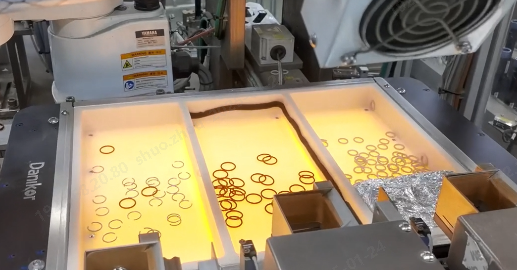
Flexible Vibratory Technology, Balancing Efficiency and Material Protection: Danikor's flexible feeder tray utilizes voice coil motor drive technology. It employs internal algorithms to precisely control various material movement patterns, enabling efficient dispersion and pose adjustment of metal shims:
Intelligent Frequency Finding: The one-key adaptive frequency function automatically determines the optimal vibration frequency for the material, completing setup in just 12 seconds. This dramatically shortens changeover commissioning time and reduces the technical expertise required from operators.
Precise Directional Control: Vibration directions can be easily adjusted via the graphical user interface, allowing for rapid correction of part position and pose, achieving "point-and-shoot" precision control.
Instant Start/Stop Design: The residual vibration time is reduced from 1 second to 0.2 seconds, effectively minimizing waiting time for vision system image capture and improving overall feeding cycle time.
Compared to traditional vibratory bowls, this solution uses a high-polymer customized tray. The gentle vibration process minimizes hard friction, effectively preventing scratches and deformation of the metal shims, significantly reducing material waste.
Integrated Vision and Robotics for High-Precision Pick-and-Place Positioning: The entire system utilizes the vision system as the "eye and brain," working in conjunction with an industrial robot to achieve precise grasping and solve the challenge of thin part positioning.
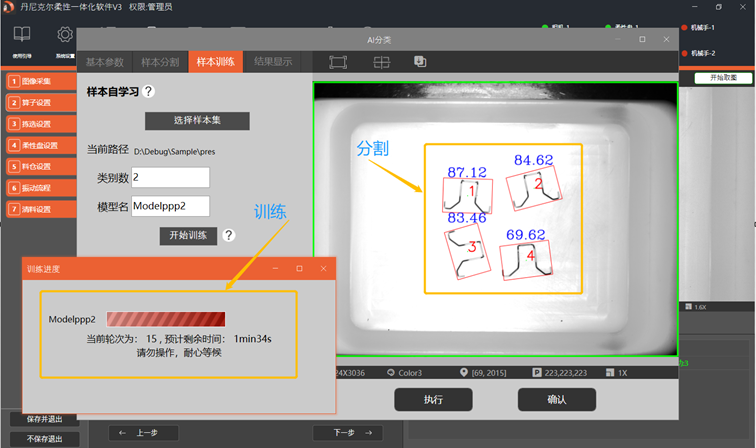
High-Precision Visual Recognition: Equipped with proprietary AI intelligent algorithms, the system can self-learn correct and incorrect part poses, automatically extracting feature points. This enables stable recognition even for metal shims with minute differences. It supports various operator combinations, such as contrast detection and contour positioning, to quickly identify part location and angular coordinates.
High Flexibility and Rapid Response to High-Mix Production: The flexible feeding system is perfectly suited for the high-mix, low-volume production model common in the electronics industry.
The compatible part size range covers 1-170mm. It supports various materials including metal, plastic, and ceramic, allowing the same equipment to handle multiple different specifications of metal shims.
Software-based changeover is convenient and material clearing is fast. Product switching can be completed without replacing hardware, significantly shortening the production changeover cycle.
III. Conclusion
As 3C electronic products continue to evolve towards miniaturization and higher precision, the demand for automated feeding of precision parts like metal shims will steadily increase. Leveraging the core advantages of "structural flexibility, control flexibility, and application flexibility," Danikor's flexible feeding system not only solves the feeding challenges posed by ultra-thin metal shims but also provides reliable technical support for electronics manufacturers transitioning towards flexible smart manufacturing. In the future, with the deep integration of AI vision and vibration control technologies, flexible feeding solutions will find widespread application in more precision manufacturing scenarios, helping the industrial manufacturing sector steadily advance towards higher quality and greater efficiency.