As key connecting components in electronic devices, automotive electronic controls, communication equipment, and more, connectors come in a wide variety of types, are made of easily damaged materials, and have irregular structures. They are widely recognized as a challenging feeding problem in automated assembly lines. Traditional rigid feeding methods can no longer meet the production demands of high variety, high precision, and low damage. Danikor's flexible feeding system offers a stable and orderly solution for the automated feeding of connectors.
.png "/uploads/image/2026/07/02/1782968164308750/1 (4).png")
I. Three Core Pain Points in Automated Connector Feeding
Pain Point 1: Irregularly Shaped Materials Prone to Jamming, Leading to Inefficient Traditional Feeders
Connectors often have irregular shapes combining plastic and pins, with significant variations in size and non-uniform external forms. Traditional vibration bowl feeders are prone to jamming, tangling, and chaotic queuing on the track. When a jam occurs, the production line must be stopped for manual clearing, which not only disrupts the production rhythm but also significantly reduces equipment utilization and affects mass production efficiency.
Pain Point 2: Material Susceptibility to Damage, with Scratches/Bent Pins Affecting Yield
Connectors made of plastic are brittle and easily scratched, while metal pins are slender and prone to deformation. High-speed friction and collisions between materials in traditional feeding processes can easily cause surface scratches, bent pins, terminal oxidation, and other issues. These directly lead to an increase in the product defect rate, affecting subsequent assembly and performance.
Pain Point 3: Difficulty Adapting to a Wide Variety of Products, with High Changeover Costs and Long Lead Times
The electronics industry sees rapid product iteration, requiring frequent changes in connector models and specifications. Traditional feeders need complete track and tooling replacements for changeovers, resulting in long debugging cycles and high costs. This makes them difficult to adapt to the flexible production needs of small-batch, high-variety manufacturing. Equipment reusability is low, and the pressure on fixed asset investment is high.
II. Danikor Flexible Feeding System for Stable and Orderly Connector Feeding
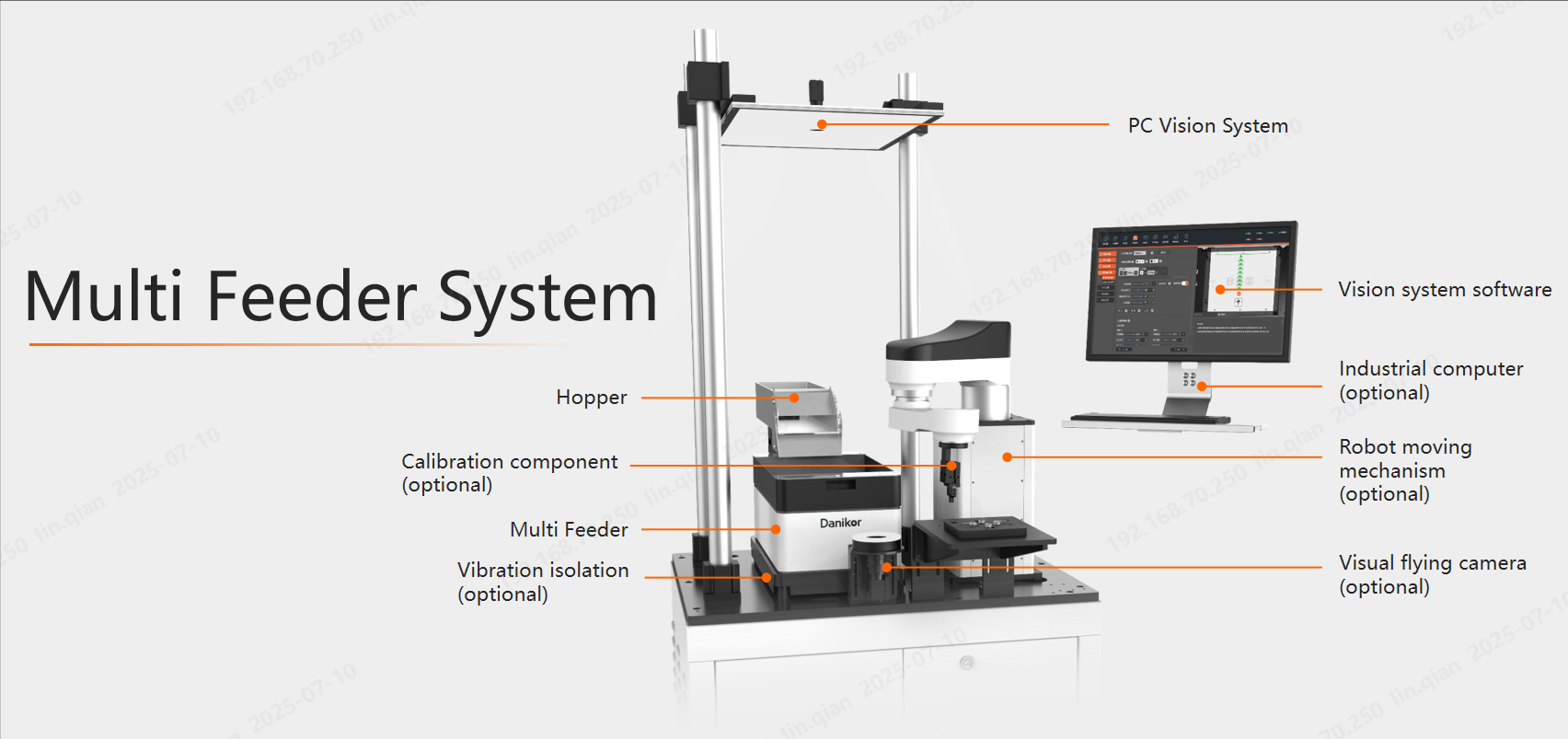
To address the industry pain points of connector feeding, Danikor offers an integrated solution centered around a flexible feeder, paired with a vision system and collaborative robots. This solution achieves stable and orderly feeding from four dimensions: material protection, identification and positioning, feeding efficiency, and multi-variety adaptability.
Advantage 1: Flexible Feeder with High-Polymer Material Bowl, Ensuring Low Damage and Jam Prevention
Danikor's flexible feeder uses a bowl made of high-polymer material, ensuring no hard friction or collision during vibration. This significantly reduces the risk of scratches on plastic parts and deformation of pins. It eliminates the jamming and tangling problems common in traditional vibration feeders, enabling stable, disorderly, and queue-free material supply. This fundamentally solves the jamming problem of irregularly shaped connectors.
Advantage 2: AI Vision System with Closed-Loop Control for Precise Recognition and Orderly Feeding
The equipment integrates a high-performance vision system equipped with self-developed AI vision algorithms. It can quickly identify connector materials in different orientations, correct material misalignment caused by vibration in real-time, and guide collaborative robots to pick them precisely. The vision system possesses self-learning capabilities for material postures, enabling efficient identification of connector models with minor visual differences. Coupled with closed-loop control logic, it ensures orderly management throughout the entire process of identification, positioning, picking, and placement, guaranteeing precise and controllable feeding.
Advantage 3: Modular Design for Rapid Changeover and Multi-Variety Production
The entire flexible feeding system features a modular design, supporting rapid changeovers for connector materials without needing to replace feeder bowls or tooling. The system is ready for production simply by importing the new material model into the vision system. When paired with collaborative robots, it can handle connectors of different specifications simultaneously, enabling mixed-model production on the same line. This significantly shortens changeover and debugging time, improves equipment reusability, and is well-suited for high-mix, low-volume production needs.
Advantage 4: End-to-End Low-Damage Process, Ensuring Material Integrity
With the flexible feeder paired with a collaborative robot, the entire process—from vibration-based separation to picking and placing—requires no manual intervention and involves no rigid contact. Combined with the protective cushioning of the high-polymer bowl, this effectively reduces the risk of material damage during the feeding process. The precise robotic picking guided by vision prevents